Insurance declaration page
An insurance declaration page is usually the first page of your policy: a summary of your coverage and its price.
Named insuredYour name and address
The person the policy is written for. Make sure the name and address are right.
Policy periodJan 1 to Jul 1
When coverage begins and ends.
CarYear, make, model, VIN
Each car the policy insures. Add a car when you buy one, and take off one you no longer own.
Bodily injury$100,000 / $300,000
A limit: the most your policy pays for each claim. Here, $100,000 for one person and $300,000 for one accident.
Collision$500 deductible
A deductible: the amount you owe in a loss before the company pays its part.
Premium$412.05
The amount you pay for the policy period, with any discounts you get.
Named insuredYour name and address
The person the policy is written for. Make sure the name and address are right.
Policy periodJan 1 to Jan 1
When coverage begins and ends.
Insured homeThe home’s address
The home the policy covers.
Dwelling$200,000
A limit: the most the policy pays if the house is damaged or destroyed. It is the estimated cost to rebuild, which is not always what the home would sell for.
Deductible$2,000
The amount you owe in a loss before the company pays its part. Wind and hail may have a deductible of their own.
Premium$1,205.95
The amount you pay for the policy period, with any discounts you get.
Free. Simple. Quick. Only the insurance agents you pick get your request.
The limits, deductibles and prices on the sample are the Texas Office of Public Insurance Counsel’s own example.
What is an insurance declaration page?
The part of your policy that is about you. It is also written “declarations page”, and often called a “dec page”.
What is on it
- Named insured
- The person the policy is written for, with their address.
- Insurance company and agent
- Who issued the policy, and your agent’s name and phone number.
- Policy number
- The number that identifies this policy.
- Policy period
- When coverage begins and ends.
- Drivers and cars, or the home
- A car policy lists each driver and each car. A home policy lists the home’s address.
- Coverages
- Each kind of protection you bought, one to a line.
- Limits
- The most the policy pays for each claim, for each coverage.
- Deductibles
- The amount you owe in a loss before the company pays its part.
- Premium
- What you pay for the policy period.
- Discounts
- Any your company gives you. Ask whether you get every one you qualify for.
- Lienholder or mortgage company
- The lender on the car or the home, when there is one. Tell your insurance company if you refinance or the loan is sold.
- Endorsements
- Changes to the policy that give you more or less coverage. They can change what you pay.
What is not on it
- ✕Exclusions. What the policy does not cover is in the policy itself, not on this page.
- ✕The whole policy. It is a summary. Read the rest too.
From the Iowa Insurance Division, the Texas Office of Public Insurance Counsel, the Texas Department of Insurance and the Maryland Insurance Administration.
How do I get my insurance policy declaration page?
You already have one if you have a policy. Three places to look:
With your policy
It comes at the front of a new policy, and a new one comes at each renewal.
From your agent
Ask for a new copy.
Online
Look in your insurance company’s online account.
Source: Iowa Insurance Division.
Is the declaration page the same as a certificate of insurance?
No. One is part of your policy. The other is a separate paper about it.
Declaration page
Part of the policy itself. It lists your coverages, limits, deductibles and what you pay.
Certificate of insurance
A short paper that sums up the coverage on the day it is issued. It is not a policy, and it cannot change what the policy covers.
Insurance ID card
The card you carry as proof of car insurance. In Pennsylvania, a copy of the declaration page counts as proof too.
Sources: Georgia Office of Commissioner of Insurance and Safety Fire, Pennsylvania Department of Transportation.
When you need your declaration page
Whenever someone has to see what you are covered for, and for how much.
For a mortgage
Lenders generally require proof that the home is insured. This page shows the coverage, its dates and your mortgage company.
To file a claim
It shows what you are covered for, and the deductible you pay first.
To shop for a new policy
It lists the coverages, limits and deductibles you have today.
Shopping? Start with this page.Texas Department of Insurance: Having the page handy will help if you need to file a claim, renew your policy, or shop for a new one.
Sources: Consumer Financial Protection Bureau, Texas Department of Insurance.
What does a declaration page look like?
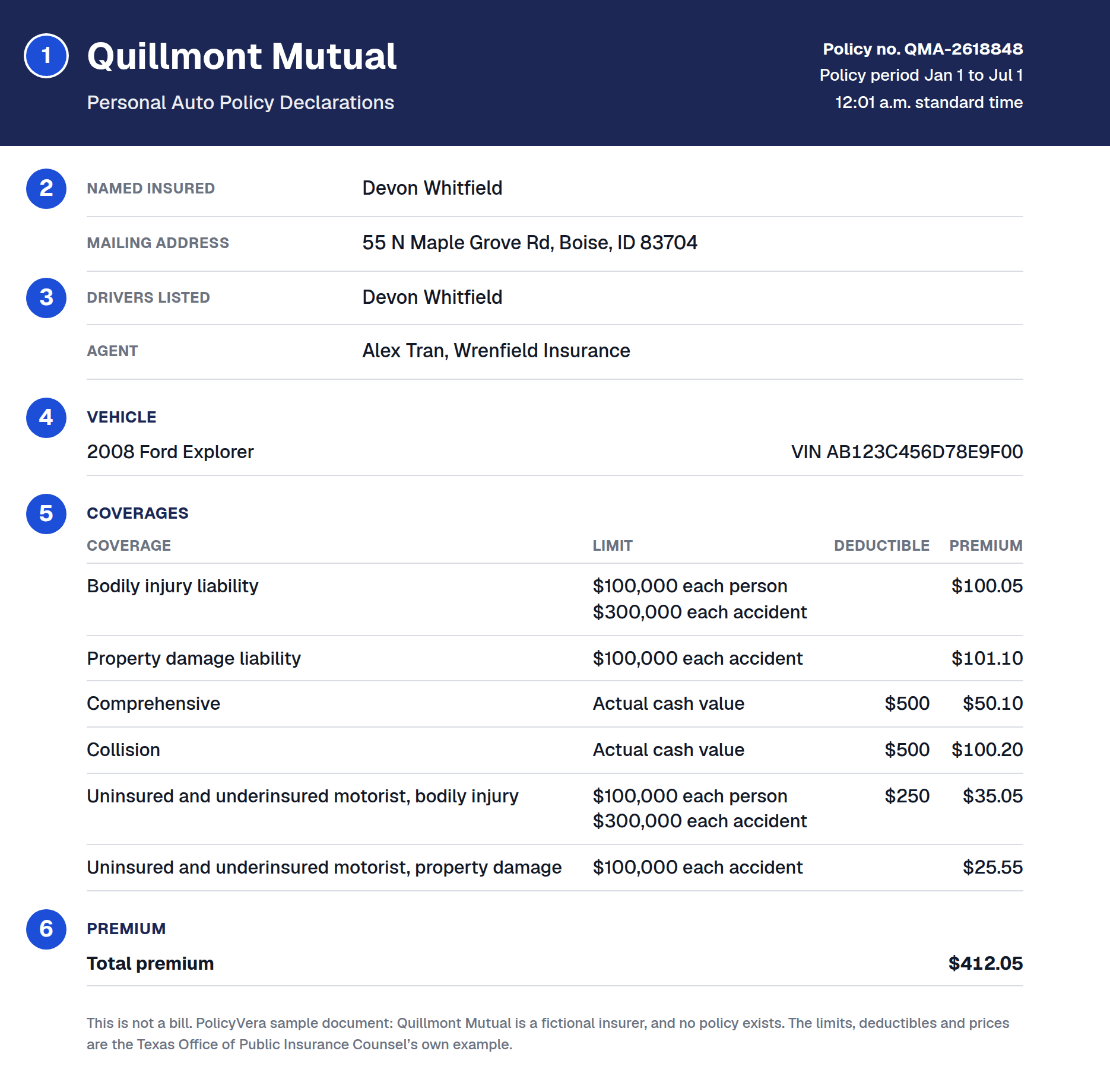
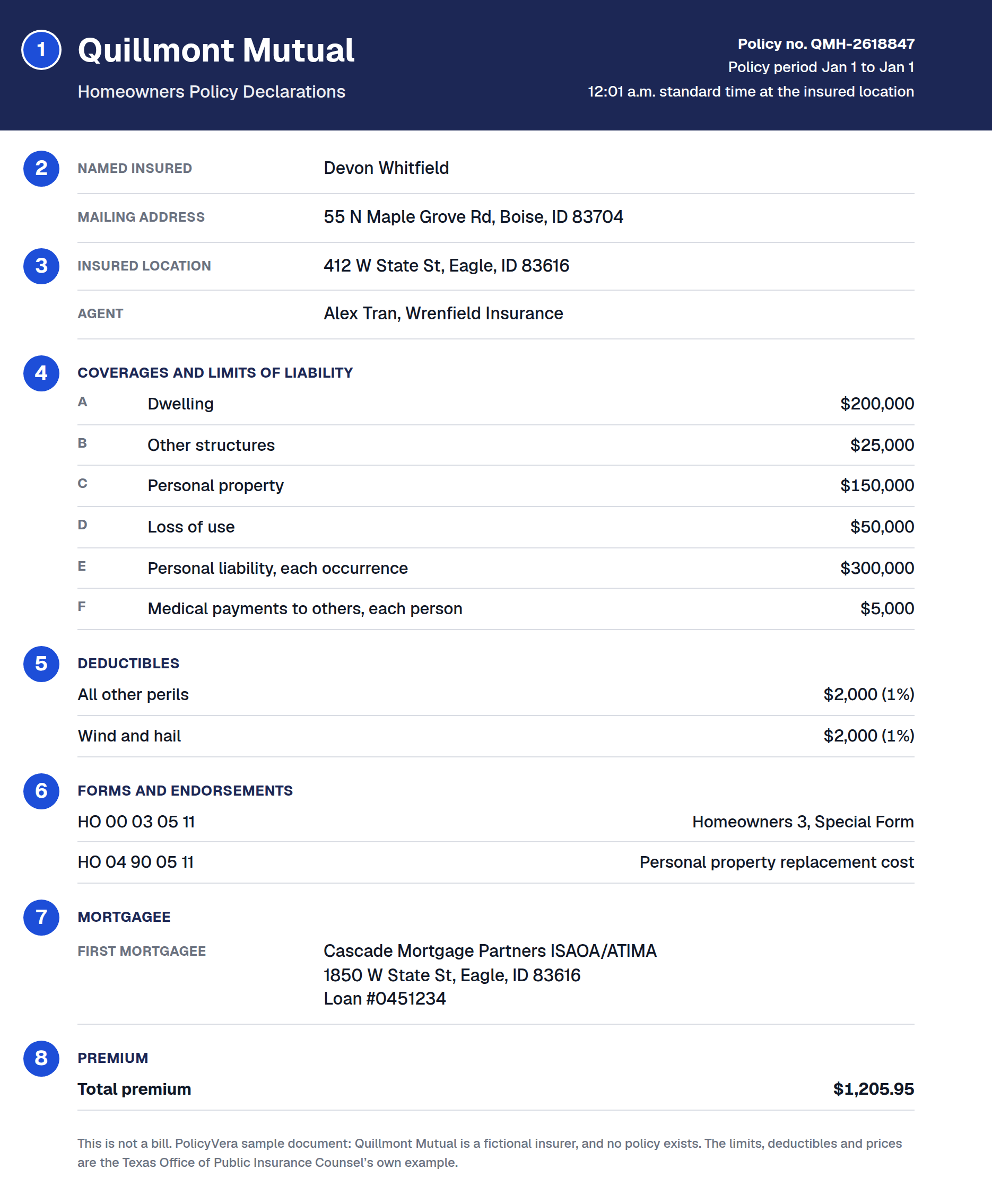
Like the sample at the top of this page: who is insured, then each coverage with its limit and deductible, then what you pay.
Car policy
 See it full size
- 1The insurer and the policy period
- 2The named insured: the person the policy is written for
- 3The drivers
- 4The car
- 5Each coverage with its limit, deductible and premium
- 6The total premium: what you pay for the policy period
Home policy
 See it full size
- 1The insurer and the policy period
- 2The named insured: the person the policy is written for
- 3The insured location: the home the policy covers
- 4Each coverage with its limit
- 5The deductibles: what you owe in a loss before the company pays its part
- 6The forms: the documents that make up the policy, and any changes to it
- 7The mortgagee: your mortgage company
- 8The total premium: what you pay for the policy period
What if something on it is wrong?
Tell your agent or insurance company right away. A mistake on the page can cause problems when you file a claim.
Source: Iowa Insurance Division.
When should I read it?
As soon as you get it: at the start, at each renewal, and after any change to the policy.
Source: Maryland Insurance Administration.
Sources
- Iowa Insurance Division: What is an Insurance Declaration Page?
- Texas Office of Public Insurance Counsel: What is a Dec Page?
- Texas Department of Insurance: How to read your auto or home insurance declarations page
- Maryland Insurance Administration: Understanding Your Automobile Insurance Declarations Page
- Maryland Insurance Administration: Understanding Your Home Owners Insurance Declarations Page
- Georgia Office of Commissioner of Insurance and Safety Fire: certificates of insurance
- Pennsylvania Department of Transportation: insurance law questions
- Consumer Financial Protection Bureau: What is homeowner’s insurance? Why is homeowner’s insurance required?
How is PolicyVera different?
What happens after you ask for a quote: three other ways, then ours.
| Where you ask | Who can call you | Who you turn to afterward |
|---|---|---|
| Another way: A form that sells your number | Every company on its list | Whoever sold you the policy |
| Another way: An online insurance agency | That one agency | That agency |
| Another way: Agents you contact yourself | Each office you contact | The agent you chose |
| PolicyVera | No one. Then only the agent you accept. | The agent you accepted. That agent is yours. |
Insurance shopping, without the spam.
Free. Simple. Quick.
- Upload your current policy page, or answer a few questions.
- Licensed local insurance agents send you quotes to compare side by side.

Wrenfield Insurance
Alex Tran

Harrowby Insurance
Marisol Vega

Fernhollow Insurance
Connor Reeves
- What to quote
- Your agents
- Your account
- Your coverage
- About you
- Your request
What do you want quotes for?
Pick all that apply.
Insurance agents are not allowed to contact you outside PolicyVera until you accept their quote and they become your agent.
More answers
- Can you change homeowners insurance at any time?Yes, on any day. Pick the day you switch and see what comes back, and the steps with a mortgage.
- Do you need home insurance before closing?Yes, with a mortgage. Enter your closing date to see the days that count and what you bring to closing.
- Can you get car insurance without a license?Yes, with a licensed main driver named on the policy. Pick your situation and see how it works.
- Auto liability insurance onlyPays others, not your car. Pick your state to see the liability it requires, and what stays with you.
- Can you have liability insurance on a financed car?Usually not: most lenders also require collision and comprehensive. Pick where you are with the car and see what stays your choice.
- Is gap insurance worth it?Worth it while you owe more than the car is worth. Type what you owe and what the car is worth to see your gap, and when to drop the coverage.
- Why is my car insurance so high?Repairs, parts and cars cost more, and that reaches every bill. Type what you pay to see it beside your state’s average.
- Home insurance calculatorPick your state and what your home would cost to rebuild, and see the average yearly price from the insurance regulators’ own count.
- How to switch car insurance companiesBuy the new policy first, and start it the day the old one ends. Pick your switch day to see your own plan, step by step.
- High risk car insuranceFor drivers some companies turn down. Pick your state to see its plan of last resort and whom to ask.