What is a mortgagee clause?
A mortgagee clause is the part of a homeowners insurance policy that names your mortgage lender as a financially protected party on the property. It tells the insurer exactly who the lender is and where insurance documents and certain claim payments involving the loan should be directed.

What the clause contains
Every lender maintains its own exact clause, and it usually has three parts:
- The lender's legal name, often followed by ISAOA and ATIMA (explained in the questions below)
- The mailing address the lender uses for insurance documents
- Your loan number, so documents match your file
The clause appears on your declarations page, on the insurance binder your lender receives before closing, and on any evidence-of-insurance forms issued later in the life of the loan.
Where to find it on your declarations page
Declarations pages follow a common top-to-bottom order: the policy number with the effective and expiration dates up top, the named insured and property address next, then the table of coverages and limits. Near the bottom sits a block usually labeled Mortgagee, Mortgagee clause, or Additional interest: that block is the clause. The same block appears on the binder your lender receives and on evidence-of-insurance forms later. If you refinance or your loan is sold, this is the block that gets updated.
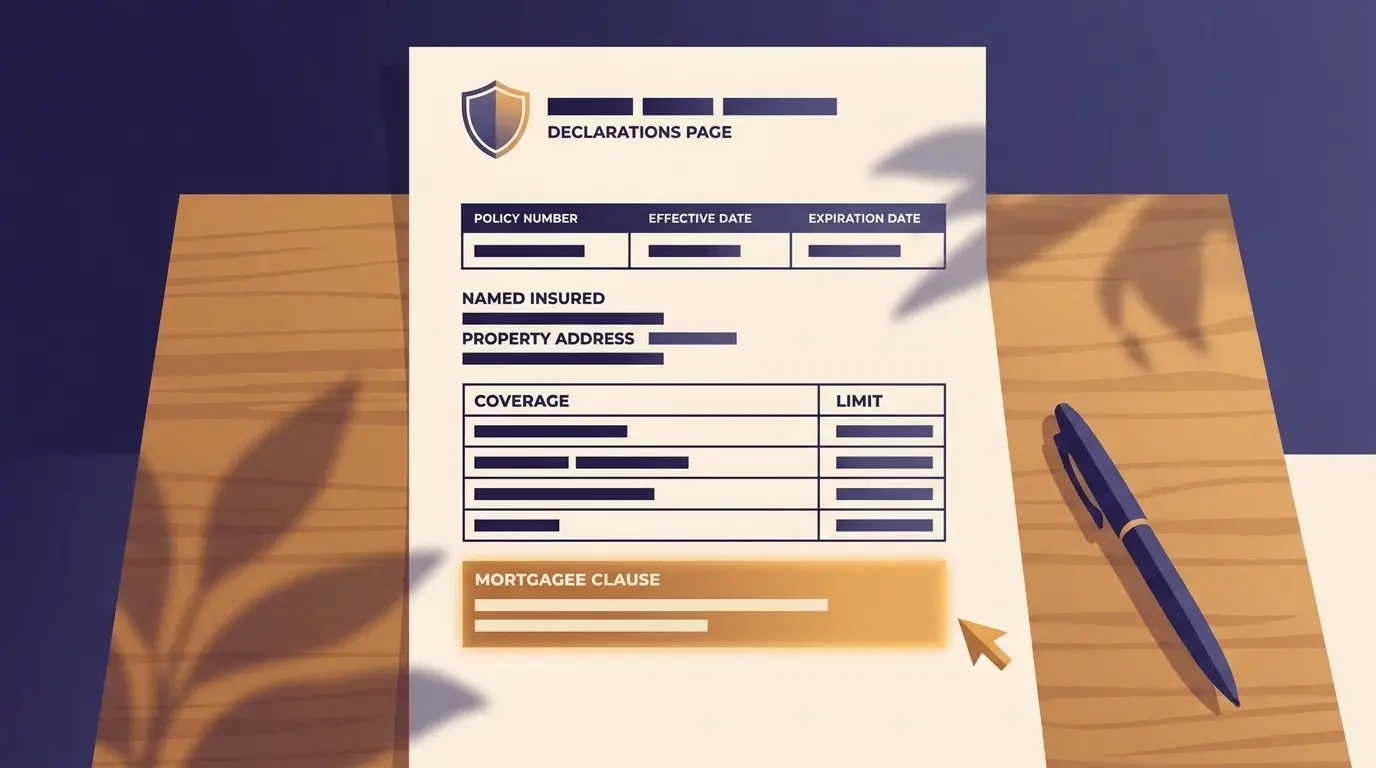
Illustrative example. Layouts vary by insurer; yours shows actual names, coverages, and dates.
Why the exact wording matters
Closing teams check the clause character by character: the legal name, the address, the loan number. If any part is off, the binder can be rejected and your closing waits for a corrected document. The fix is simple: never guess or copy a clause from a search result. Ask your lender for the exact language and give it to your agent as provided.
How it works during a home purchase
- Your lender gives you (or your insurance agent) its exact mortgagee clause and your loan number.
- Your agent sets up the homeowners policy with the clause included from day one.
- The binder listing the clause goes to the lender's closing team before your closing date.
- After closing, the insurer keeps the lender informed about the policy, as the clause requires.
PolicyVera keeps the clause exact
When your lender is on PolicyVera, they share the exact mortgagee clause language with your agent through the platform, so the binder is issued right the first time and your closing is not held up by a paperwork mismatch. You compare quotes from licensed local agents, choose your agent, and the documents flow to the right place.
Common questions
What do ISAOA and ATIMA mean?
Who gives me the mortgagee clause?
Is the mortgagee the lender or me?
What happens if the mortgagee clause is wrong?
Does adding a mortgagee clause cost anything?
Related guides
What is an insurance binder?
The temporary proof of coverage your lender needs before closing, and how to get it.
What is hazard insurance?
The part of a homeowners policy your lender requires, and why you don't buy it separately.
What does clear to close mean?
Underwriting's final approval, the three-day rule, and the last steps before keys.
Setting up insurance for a mortgaged home?
Compare quotes from licensed local agents and keep every closing document in one place.